
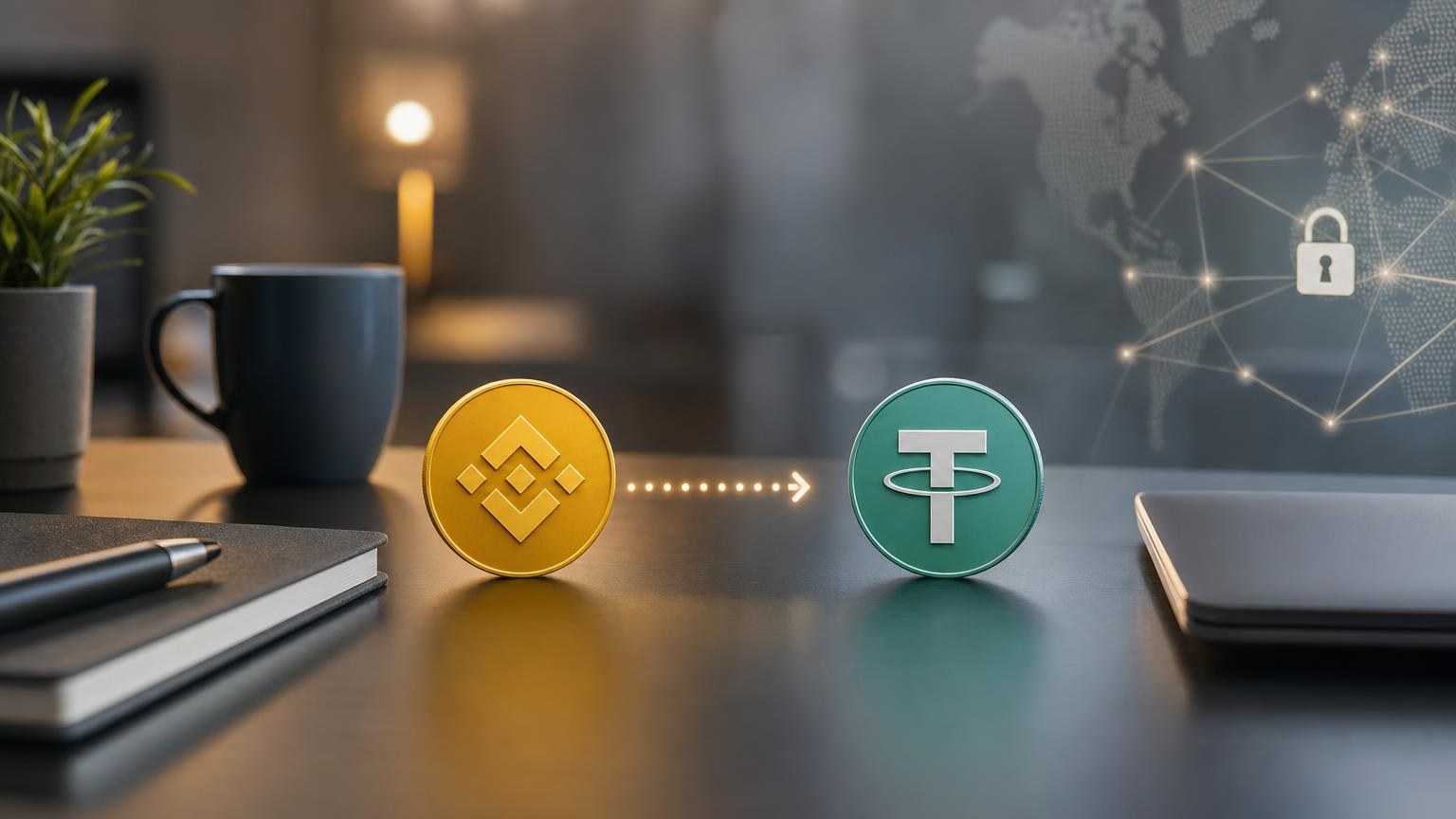
To exchange BNB for USDT safely, compare routes rather than treating “BNB to USDT” as a single universal pair. The source network determines where you can send BNB, while the destination network determines which version of USDT you receive. The correct route is the one supported at every point: your sending wallet, the exchange service, and the receiving wallet or platform.
What Should Be Compared?
The meaningful comparison starts with native BNB held on BNB Smart Chain and considers several possible USDT payout networks. BNB is the native utility token of BNB Smart Chain and pays transaction fees on that network. BSC Mainnet uses chain ID 56 and is EVM-compatible. [1]
USDT exists on multiple blockchains. Tether’s official protocol information lists BNB Smart Chain, Ethereum, and TRON among the networks on which USD₮ is issued. That does not mean a particular exchanger supports every one of these routes. Current pair availability, deposit networks, payout networks, limits, and compliance requirements must be checked before creating an order. [2]
The comparable routes for a holder of native BNB on BSC are therefore:
- BNB on BSC → USDT on BSC: source and destination remain in the same blockchain ecosystem.
- BNB on BSC → USDT on Ethereum: the service receives BNB through BSC and pays out ERC-20 USDT, if this cross-network direction is available.
- BNB on BSC → USDT on TRON: the service receives BNB through BSC and pays out TRC-20 USDT, if supported.
These routes lead to economically similar units of USDT but operationally different assets. USDT on BSC cannot be deposited into an address or platform entry that accepts only USDT on Ethereum or TRON.
Stop Criteria: When a Route Is Immediately Unsuitable
Eliminate a route before comparing its quote if any of the following conditions applies:
- The BNB deposit network does not match your holdings. Native BNB on BSC is not the same operational asset as a wrapped token on another blockchain.
- The recipient does not support the chosen USDT network. A deposit page specifying ERC-20, TRC-20, or BSC must be followed exactly.
- The route is unavailable in the order interface. General support for BNB and USDT does not prove that a specific network combination is active.
- The recipient address format is inconsistent with the selected network. TRON addresses are commonly displayed in Base58Check form beginning with “T,” while BSC and Ethereum use EVM-style addresses. [3]
- You cannot cover the source transaction fee. Sending native BNB on BSC requires enough BNB for gas.
- You will be unable to move the received USDT later. A self-custody wallet normally needs the destination network’s native resource asset: BNB on BSC, ETH on Ethereum, or TRX/resources on TRON.
- The amount is outside the currently displayed limits or the verification conditions are unacceptable. Limits and compliance checks are dynamic and may differ by direction and transaction risk assessment.
BNB Beacon Chain, formerly associated with BEP-2 transfers, should not be selected as though it were an alternative active route for a new transaction. BNB Chain completed its migration of Beacon Chain functions to BNB Smart Chain and retired the former chain; recovery procedures for certain legacy assets are separate from an ordinary exchange. [4]
Decision Matrix Based on Constraints
| Criterion | Meaning for the exchange | Routes that pass or fail | Material limitation | What to verify |
|---|---|---|---|---|
| Source form of BNB | The deposit must accept the exact network on which the BNB is held. | All three compared payout routes may pass only if BSC is accepted as the BNB input network. Legacy BEP-2 or wrapped BNB fails unless explicitly supported. | A familiar ticker does not prove network compatibility. | Wallet network, asset contract if applicable, and deposit-network label. |
| Recipient’s required USDT network | The payout network must match the recipient’s deposit instructions. | BSC passes for a BSC recipient; Ethereum passes for an ERC-20-only recipient; TRON passes for a TRC-20-only recipient. The other routes fail. | The recipient’s requirement overrides convenience or estimated cost. | Accepted network, address, memo or other required identifier, and deposit status. |
| Ability to use received funds | USDT in self-custody needs the destination network’s native fee asset for a later transfer. | BSC suits a wallet with BNB; Ethereum suits a wallet with ETH; TRON suits an account with adequate TRX, Bandwidth, or Energy arrangements. | Receiving USDT does not automatically provide gas or network resources. | Native-asset balance and the wallet’s support for the selected token standard. |
| Address and network consistency | The address must belong to the selected destination network and be controlled by the intended recipient. | Only the route matching the confirmed destination passes. | BSC and Ethereum may display similar “0x” addresses, but they are separate chains. A matching-looking address is not proof that the recipient supports both. | Network label, full address, first and last characters, and recipient confirmation. |
| Current total exchange result | The useful comparison is the final USDT amount after all displayed service and network deductions. | Any available route may pass after a live quote comparison. | Rates, fees, network load, limits, and order validity can change; no route is permanently cheapest or fastest. | Deposit amount, payout amount, listed deductions, minimum, maximum, and quote validity. |
| Compliance and regional conditions | The order may be subject to checks depending on its direction and compliance results. | Only routes available to the user under the current conditions pass. | Requirements can vary by transaction and country. | Required information, possible verification steps, and applicable local restrictions before sending funds. |
How the Main Routes Differ
USDT on BNB Smart Chain
This is the most direct operational fit when the BNB is already on BSC and the recipient also accepts USDT on BSC. It avoids choosing a different payout ecosystem and leaves the received token in a wallet where BNB is used for transaction fees. BNB Chain documentation also notes that tokens sent on BSC will not appear under another network merely because the same wallet application supports both. [5]
The route fails as soon as the final recipient accepts only ERC-20 or TRC-20 deposits. Sending BSC USDT to an unsupported exchange deposit may require a difficult recovery process or result in permanent loss.
USDT on Ethereum
Ethereum is relevant when the recipient explicitly requires ERC-20 USDT or the funds will be used in an Ethereum-based application. Ethereum transactions consume gas paid in ETH, and the applicable fee depends partly on network demand at the time of execution. [6]
The route should not be rejected solely because another network is often perceived as less expensive. The decisive constraint may be compatibility: if an exchange or contract accepts only Ethereum USDT, a lower quoted fee on an incompatible network has no practical value. Check both the exchanger’s payout deduction and the ETH required for any later self-custody transaction.
USDT on TRON
TRC-20 USDT is suitable when the recipient provides a TRON address and confirms TRC-20 support. TRON uses Bandwidth for transaction data and Energy for smart-contract execution. If the account lacks sufficient resources, TRX may be consumed under the network’s resource model. [7]
This route is unsuitable for an Ethereum or BSC destination even if the same person controls wallets on those networks. Confirm the displayed “T” address, selected TRON network, and ability to obtain TRX or delegated resources if the USDT will later be transferred from self-custody.
Why There Is No Universal Winner
Consider three contrasting requirement sets. If BNB is held on BSC, the recipient supports BSC USDT, and the user already has BNB for later gas, the BSC-to-BSC route removes unnecessary network changes. If the recipient is a platform that accepts only ERC-20 USDT, changing that single constraint makes Ethereum the valid route regardless of whether another option displays a more attractive quote. If a merchant provides only a TRON deposit address, TRC-20 becomes the relevant destination.
The conclusion changes again when the recipient is a self-custody wallet with no native gas asset. The payout may arrive successfully, yet remain difficult to move until BNB, ETH, or TRX resources are available. Network selection must therefore account for what happens after receipt, not only the exchange screen.
Before funding an order, check the currently available BNB-to-USDT routes and network conditions. Confirm that the selected input and payout networks are both shown in the order interface rather than inferred from the list of supported assets.
Safe Exchange Procedure
- Identify the source asset. Open the sending wallet and confirm that the balance is native BNB on BNB Smart Chain, not a similarly named token on another network.
- Obtain the recipient’s exact requirements. Copy the USDT network and address from the receiving wallet or deposit page. Check whether an additional memo or identifier is required.
- Choose the route by destination compatibility. Select BSC, Ethereum, or TRON only if that payout network is currently offered and accepted by the recipient.
- Review the live order conditions. Compare the required BNB deposit with the final USDT payout, displayed deductions, limits, order validity, and any verification requirements.
- Keep enough BNB for gas. Do not attempt to send the wallet’s entire BNB balance if that leaves nothing to pay the BSC transaction fee.
- Verify the deposit details again. Malware can replace copied addresses. Compare the complete address or, at minimum, multiple characters at both ends and the selected network.
- Send only according to the created order. Follow its amount and timing instructions. Do not reuse an old deposit address unless the service explicitly states that it remains valid.
- Track the transaction independently. Use the relevant blockchain explorer to verify the transaction hash, status, address, and network. Contact support through the service’s official channel if the blockchain transfer is confirmed but the order is not updated.
Final Checklist
- The BNB source network matches the exchange deposit network.
- The USDT payout network matches the recipient’s instructions exactly.
- The route is currently available for the intended amount.
- The displayed payout, deductions, limits, and quote validity have been reviewed.
- Enough BNB remains to pay the source transaction fee.
- The recipient can later obtain BNB, ETH, or TRX resources if self-custody USDT must be moved.
- The address has been checked for clipboard replacement and phishing.
- Current compliance requirements and regional restrictions are acceptable.
- No funds are sent through the retired BNB Beacon Chain route.
Blockchain transfers are generally irreversible after confirmation, and neither a correct asset ticker nor a familiar address format compensates for a wrong network. The safest BNB-to-USDT route is the one that satisfies every compatibility constraint and remains acceptable after its dynamic quote, limits, fees, and verification conditions are checked immediately before the transaction.